Thursday, October 19, 2017

Hack.lu 2017 Wrap-Up Day 2

As said yesterday, the second day started very (too?) early… The winner of the first slot was Aaron Zauner who talked about pseudo-random numbers generators. The complete title of the talk was “Because ‘User Random’ isn’t everything: a deep dive into CSPRGNs in Operating Systems & Programming Languages”. He started with an overview of random numbers generators and why we need them. They are used almost everywhere even in the Bash shell where you can use ${RANDOM}.  CSPRNG is also known as RNG or “Random Number Generator”. It is implemented at operating system level via /dev/urandom on Linux on RtlGenRandom() on Windows but also in programming languages. And sometimes, with security issues like CVE-2017-11671 (GCC fails to generate incorrect code for RDRAND/RDSEED. /dev/random & /dev/urandom devices are using really old code! (fro mid-90’s). According to Aaron, it was a pure luck if no major incident arises in the last years. And today? Aaron explained what changed with the kernel 4.2. Then he switched to the different language and how they are implementing random numbers generators. He covered Ruby, Node.js and Erlang. All of them did not implement proper random number generators but he also explained what changed to improve this feature. I was a little bit afraid of the talk at 8AM but it was nice and easy to understand for a crypto talk.

The next talk was “Keynterceptor: Press any key to continue” by Niels van Dijkhuizen. Attacks via HID USB devices are not new. Niels reviewed a timeline with all the well-known attacks from 2005 with the KeyHost USB logger until 207 with the BashBunny. The main problems with those attacks: they need an unlocked computer, some social engineer skills and an Internet connection (most of the time). They are products to protect against these attacks. Basically, they act as a USB firewall: USBProxy, USBGuest, GoodDog, DuckHunt, etc. Those products are Windows tools, for Linux, have a look at GRSecurity. Then Niels explains how own solution which gets rid of all the previous constraints: his implants is inline between the keyboard and the host. It must also have notions of real)time. The rogue device clones itself as a classic HID device (“HP Elite USB Keyboard”) and also adds random delays to fake a real human typing on a keyboard. This allows bypassing the DuckHunt tool. Niels makes a demonstration of his tool. It comes with another device called the “Companion” which has a 3G/4G module that connects to the Keynterceptor via a 433Mhz connection. A nice demo was broadcasted and his devices were available during the coffee break. This is a very nice tool for red teams…

Then, Clement Rouault, Thomas Imbert presented a view into ALPC-RPC.The idea of the talk: how to abuse the UAC feature in Microsoft Windows.They were curious about this feature. How to trigger the UAC manually? Via RPC! A very nice tool to investigate RPC interface is RpcView. Then, they switched to ALPC: what is it and how does ir work. It is a client/server solution. Clients connect to a port and exchange messages that have two parts: the PORT_MESSAGE header and APLC_MESSAGE_ATTRIBUTES. They explained in details how they reverse-engineering the messages and, of course, they discovered vulnerabilities. They were able to build a full RPC client in Python and, with the help of fuzzing techniques, they found bugs: NULL dereference, out-of-bounds access, logic bugs, etc. Based on their research, one CVE was created: CVE-2017-11783.

After the coffee break, a very special talk was scheduled: “The untold stories of Hackers in Detention”. Two hackers came on stage to tell how they were arrested and put in jail. It was a very interesting talk. They explained their personal stories how they were arrested, how it happened (interviews, etc). Also gave some advice: How to behave in jail, what to do and not do, the administrative tasks, etc. This was not recorded and, to respect them, no further details will be provided.

The second keynote was assigned to Ange Albertini: “Infosec and failure”. Ange’s presentation are always a good surprise. You never know how he will design his slides.As he said, his talk is not about “funny” failures. Infosec is typically about winning. The keynote was a suite of facts that prove us that we usually fail to provide good infosec services and pieces of advice, also in the way we communicate to other people. Ange likes retro-gaming and made several comparisons between the gaming and infosec industries. According to him, we should have some retropwning events to play and learn from old exploits. According to Ange, an Infosec crash is coming like the video game industry in 1983 and a new cycle is coming. If was a great keynote with plenty of real facts that we should take care of! Lean, improve, share, don’t be shy, be proactive.

After the lunch, I skipped the second session of lightning talks and got back for “Sigma – Generic Signatures for Log Events” by Thomas Patzke. Let’s talk with logs… When the talk started, my first feeling was “What? Another talk about logs?” but, in fact, it was interesting. The idea behind Sigma is that everybody is looking for a nice way to detect threats but all solutions have different features and syntax. Some example of threats are:

  • Authentication and accounts (large amount of failed logins, lateral movement, etc.)
  • Process execution (exec from an unusual location, unknown process relationship, evil hashes, etc…
  • Windows events

The problem we are facing: there is a lack of standardised format. Here comes Sigma. The goal of this tool is to write use case in YAML files that contain all the details to detect a security issue. Thomas gave some examples like detecting Mimikatz or webshells.

Sigma comes with a generator tool that can generate queries for multiple tools: Splunk, Elasticsearch or Logpoint. This is more complex than expected because field names are different, there are inconsistent file names, etc. In my opinion, Sigma could be useful to write use cases in total independence of any SIEM solution. It is still an ongoing project and, good news, recent versions of ISP can integrate Sigma. A field has been added and a tool exists to generate Sigma rules from MISP data.

The next talk was “SMT Solvers in the IT Security – deobfuscating binary code with logic” by Thaís Moreira Hamasaki. She started with an introduction to CLP or “Constraint Logic Programming”. Applications in infosec can be useful like malware de-obfuscation. Thais explained how to perform malware analysis using CLP. I did not follow more about this talk that was too theoretical for me.

Then, we came back to more practical stuff with Omar Eissa who presented “Network Automation is not your Safe Haven: Protocol Analysis and Vulnerabilities of Autonomic Network”. Omar is working for ERNW and they always provide good content. This time they tested the protocol used by Cisco to provision new routers. The goal is to make a router ready for use in a few minutes without any configuration: the Cisco Autonomic network. It’s a proprietary protocol developed by Cisco. Omar explained how this protocol is working and then how to abuse it. They found several vulnerabilities

  • CVE-2017-6664: There is no way to protect against malicious nodes within the network
  • CVE-2017-6665 : Possible to reset of the secure channel
  • CVE-2017-3849: registrar crash
  • CVE-2017-3850: DeathKiss – crash with 1 IPv6 packet
The talk had many demos that demonstrated the vulnerabilities above. A very nice talk.

The next speaker was Frank Denis who presented “API design for cryptography”. The idea of the talk started with a simple Google query: “How to encrypt stuff in C”. Frank found plenty of awful replies with many examples that you should never use. Crypto is hard to design but also hard to use. He reviewed several issues in the current crypto libraries then presented libhydrogen which is a library developed to solve all the issues introduced by the other libraries. Crypto is not easy to use and developer don’t read the documentation, they just expect some pieces of code that they can copy/paste. The library presented by Frank is called libhyrogen. You can find the source code here.

Then, Okhin came on stage to give an overview of the encryption VS the law in France. The title of his talk was “WTFRance”. He explained the status of the French law against encryption and tools. Basically, many political people would like to get rid of encryption to better fight crime. It was interesting to learn that France leads the fight against crypto and then push ideas at EU level. Note that he also mentioned several politician names that are “against” encryption.

The next talk was my preferred for this second day: “In Soviet Russia, Vulnerability Finds You” presented by Inbar Raz. Inbar is a regular speaker at hack.lu and proposes always entertaining presentations! This time he came with several examples of interesting he found “by mistake”. Indeed, sometimes, you find interesting stuff by accident. Inbar game several examples like an issue on a taxi reservation website, the security of an airport in Poland or fighting against bots via the Tinder application. For each example, a status was given. It’s sad to see that some of them were unresolved for a while! An excellent talk, I like it!

The last slot was assigned to Jelena Milosevic. Jelena is a nurse but she has also a passion for infosec. Based on her job, she learns interesting stuff from healthcare environments. Her talk was a compilation of mistakes, facts and advice for hospitals and health-related services. We all know that those environments are usually very badly protected. It was, once again, proven by Jelena.

The day ended with the social event and the classic Powerpoint karaoke. Tomorrow, it will start again at 08AM with a very interesting talk…

[The post Hack.lu 2017 Wrap-Up Day 2 has been first published on /dev/random]


from Xavier

Event recap: Security at Microsoft Ignite

Microsoft Ignite recently gathered 24,000+ attendees from around the world in Orlando, FL. CEO Satya Nadella kicked off an exciting week with his Vision Keynote by articulating how we enable digital transformation, specifically through empowering employees, engaging customers, optimizing operations, and finally through transforming products.

Commitment to security, privacy, and transparency

At the event, Microsoft reaffirmed its commitment to security, privacy, and transparency to its customers and partners through all the four main solution areas: Modern Workplace, Business Applications, Applications & Infrastructure, and Data & Artificial Intelligence. Julia White explained Microsofts approach to security during her session, Microsoft 365: Step up your protection with intelligent security.

Learnings from our customers and partners

During the event, the Microsoft team had the privilege to engage in 410,000 unique interactions within the Expo. In addition, 8,000+ labs were consumed, 54 sessions, two general sessions, 40 breakout sessions across CE, Windows and Office 365 tracks and 12 theater sessions. Our top three security takeaways were:

  1. Build awareness of Microsofts commitment to security and privacy
  2. Early and frequent product updates communications
  3. Transparency from Microsoft equates to trust from customers

Key security related sessions to check out

Key security sessions we recommend you check out are based entirely upon feedback from our customers and partners who attended the sessions. Please take a moment to watch them and learn about new ways you can improve the security posture of your organization.

On demand access to content

All breakout sessions and general sessions were recorded for on demand viewing. These recordings are now available at Microsoft Ignite on demand sessions. Please continue to share this link with your customers and partners. Labs will be available for 6 months through MyIgnite.

Conclusion

Microsoft Ignite was a fantastic week for all who attended. We not only shared product visions, but also, we listened and learned from engagements with customers and partners. With continued advances in our security offerings and development in better ways for partners to build a more modern, collaborative and secure work environment, it will be an exciting year for Security.


from Microsoft Secure Blog Staff

Wednesday, October 18, 2017

Hack.lu 2017 Wrap-Up Day 1

Hack.lu is ongoing in Luxembourg, already the thirteen edition! I arrived yesterday to attend a pre-conference event: the MISP summit. Today the regular talks were scheduled. It seems that more attendees joined this edition. The number of talks scheduled is impressive this year: 11 talks today and 12 talks on Wednesday and Thursday… Here is my wrap-up of the first day!

The first talk was not technical but very informative: “Myths and realities of attribution manipulation” presented by Félix Aimé & Ronan Mouchoux from Kaspersky. Many companies put more and more efforts in infowar instead of simple malware research. This affects many topics: cyber espionage, mass opinion manipulation or sabotage. The key is to perform attribution by putting a name on a cyber attack. You can see it as putting a tag on an attack. Note that sometimes, attribution suffers from a lack of naming convention like in the AV industry. Not easy to recognise the different actors. To perform this huge task, a lot of time and skills are required. They are many indicators available but many of them can be manipulated (ex: the country of origin, the C2, …). After a definition of attribution and the associated risks, Félix & Ronan reviewed some interesting examples:

  • The case of Turkey.TR domains that were DDoS after the Russian planes crashed
  • The case of Belgium accused to have done an airstrike against the locality of Hassadjek. A few days later, some Belgian media websites were DDoS’d.
As a conclusion to the talk, I like the quote: “You said fileless malware? APT actors try now to be less actor”.

The second slot was assigned to Sébastien (blotus) Blot, Thibault (buixor) Koechlin, Julien (jvoisin) Voisin who presented their solution to improve the security of PHP websites: Snuffleupagus (don’t ask me to pronounce it ;-). The complete title was: “Snuffleupagus – Killing bugclasses in PHP 7, virtual-patching the rest”. The speakers are working for a company provided hosting services and many of their customers are using PHP websites. Besides the classic security controls (OS-level hardening, custom IDS, WAF, …) they searched for a tool to improve the security of PHP. Suhosin is a nice solution but it does not support PHP7. So they decided to write their own tool: Snuffleupagus. They reviewed how to protect PHP with very nice features like the disable_function() feature. Some examples:

sp.disable_function.function(“system”).filename(“foo.php”).allow();
sp.disable_function.function(“system”).filename(“foo.php”).hash(“xxxx”).allow();

You can also restrict parameters passed to functions:

… param(“command”).value_r(“[$|…”).drop();

Then, the speakers demonstrated real vulnerabilities in a well-known tool written in PHP and how their solution could mitigate the vulnerabilities. This is a really nice project still in development but already used by many websites from the Alexa top-ranking list! The project is available here.

After a coffee break, Bouke van Leathem presented his project: “Randori”. In Japanse, Randori is a form of practice in which a designated aikidoka defends against multiple attackers in quick succession. To make it short, it’s the principle of action-reaction: You scan me, I scan you. Randori is a low interaction honeypot with a vengeance as defined by Bouke. The main idea is to reuse the credentials tested by the attackers against themselves. Bouke explained how it developed his honeypot, mainly the pam_randori PAM module. Collected credentials are re-used, no more no less, no code is executed on the remote system. Based on the collected information, Bouke explained in the second part of his talk, how he generated useful statistics to build botnet maps. One of the tools he used for this purpose is ssdeep. Note that the tool can be used in different ways: from an incident responder or ethical hacker perspectives. This project is very interesting and is also available here.

Before the lunch break, we had a keynote. The slot was assigned to Sarah Jamie Lewis and had the title: “Queer Privacy & Building Consensual Systems”. She started with a nice definition of privacy: “Privacy is the right to share information about you… only with people you trust”. Sarah wrote a book (with the same name as her keynote) and used it to illustrate her keynote. She read samples stories about Kath, Ada, Morgan. All those people had privacy issues and have to protect themselves. During the keynote, Sarah looked really affected by those stories but was it the right place to read some samples? I’m not sure. It looks to be a book that you have to read at home, relaxed and not at a security conference (just my $0.02). About privacy, as usual, the facts reviewed during the keynote were the same: our privacy is always threatened and there is a clear lack of solution.

After the lunch, a first lightning talk session was organized followed by Raúl B. Netto’s presentation: “ManaTI: Web Assistance for the Threat Analyst, supported by Domain Similarity”. ManaTI is a project to use machine learning techniques to assist an intuitive threat analyst to help in the discovery of security issues. I missed this talk because I was out with friends.

Then Paul Rascagnères, a regular speaker at hack.lu, came to present tools and techniques to help in debugging malware code written in .Net. This framework is the key component of many Microsoft tools like Powershell. With a nice integration with the operating system, it is also used by bad guys to produce malicious code. Paul started by explained some .Net techniques used by malware (like Assembly.load()). The next part of the talk focused on PYKD, a Python extension for the WinDBG debugger. In a demo, Paul demonstrated how easy it is to use PYKD to debug malicious code.

The next talk was my preferred for this first day: “Device sensors meet the web – a story of sadness and regret” by Lukasz Olejnik. The idea behind this talk was to demonstrate how our privacy can be affected by connected devices or, simply, our browsers. All devices today handle plenty of personal data but web technologies were not designed with privacy in mind. With the modern web, a browser on your smartphone can take advantage of many sensors or connectivity (USB, NFC or Bluetooth). Modern devices have an API that can be queried by web browsers. The first example that Lukasz gave was the batteries. The power level can be queried from a browser. That’s a nice feature indeed but what about privacy issues? Firebox, by abusing the high precision readout can get useful information about the user behaviour. There are also evil scenarios: Just imagine that somebody is looking for a taxi and his /her battery is almost dead. The idea is to go back asap to home. If the taxi reservation page proposes 2 prices: 10€ for a 10 minutes drive and 5€ for a 30 minutes drive, guess which one will be chosen by the customer? Another example, even crazier, was the (ab)use of the light sensor in mobile phones. Lucasz demonstrated how it is possible to steal the browser history via the light sensor: The display emits light that reflects on objects and can be read/decoded. Scary! And other examples are multiple: tracking, behaviour, fingerprinting, etc… How to mitigate this? Not easy, ask permission to the user to access the data, disable the API, purge it from dangerous calls? Finally, Lucasz gave the last example with web payments (in one click) that also have security issues. This was a very nice talk with plenty of examples that should really open our eyes!

After the afternoon coffee break, Maxime Clementz and Antoine Goichot came on stage to present: “Malicious use of Microsoft Local Administrator Password Solution”. The local admin problem is not new with Microsoft operating systems. This account must be present and, within old environments, the password was often the same across all devices in the domain. This makes lateral movement so easy! To solve this issues, Microsoft implemented LAPS or “Local Administrator Password Solution”. How does it work? Random passwords are generated for the local admin. The goal of the talk was to explain how to perform privilege escalation within an environment that has LAPS deployed. In fact, this tools is not new. It was an open source project that was integrated into Microsoft Windows, a client-side extension (CSE). It’s just a DLL called AdmPwd.dll. First observation: the DLL is not signed and does not implement integrity checks. The idea of the PoC was to create a rogue DLL that ignores the temporary password expiration data and write generated passwords in a simple text file. It worked very well. Their recommendation to mitigate this kind of attack: validate the integrity/signature of the DLL.

The next presentation was about cars: “The Bicho: An Advanced Car Backdoor Maker” by Sheila Ayelen Berta. If we see more and more talks about connected cars, this time, it focused on “regular” cars that just have a CAN bus. Sheila explained the tools and hardware that helps to inject commands on a CAN bus. To achieve this, she used a platform called CANspy to sniff messages on a CAN bus. Then, via another tool called “Car Backdoor Maker 1.0”, she was able to generate CAN bus message. Basically, it’s a replay attack. A website has been created to list all CAB messages discovered: opencandb.online. The payload is injected using a microcontroller connected to the CAN bus. It also has GPS capabilities that allow sending the CAN bus message depending on the cat localisation! The payload generator is available here.

Then, we came back to the issues regarding sharing information. Becky Kazansky presented: “Countering Security Threats by Sharing Information: Emerging Civil Society Practices”. I skipped this talk.

Finally, the first day finished with Parth Suhkla who presented “Intel AMT: Using & Abusing the Ghost in the Machine”. The presentation started with an overview of the AMT technology. It means “Active Management Technology” and is an out-of-band, management platform, embedded into Intel chipsets. The goal is to offer remote management capabilities without any OS. You can imagine that this feature looks juicy to attackers! Parth reviewed the core features of AMT and how it works. One important step is the provisioning options (can be performed via a local agent, remotely, via USB or the BIOS). There was already vulnerabilities discovered in AMT like the INTEL-SA-00075 that covered a privilege escalation issue. AMT was also used by the PLATINIUM attacker group who used the Serial Over LAN as a back channel. In the second part, Parth explained his research: how to abuse AMT? The requirements of the attack were:

  • Control the AMT
  • Implement persistence
  • Be stealthy
He reviewed all the possible scenarios with a rating (complex, easy, …). For each attack, if also explained how to mitigate and detect such attacks. Some interesting ideas:
  • Detect usual AMT ports in the network traffic
  • Query the ME interface for AMT status (easy on Windows, no tool for Linux)
  • Verify the book chain
  • Encrypt disk drives with the TPM chipset
  • Protect your BIOS (you already did it right?)
The last part covered the forensics investigations related to AMT. Again, an interesting talk.
That’s all for today! Note that talks have been recorded and are already available on Youtube! After our classic “Belgian dinner”, it’s time to take some hours of sleep, tomorrow 12 talks are scheduled! Stay tuned for more wrap-ups!

[The post Hack.lu 2017 Wrap-Up Day 1 has been first published on /dev/random]


from Xavier

Tuesday, October 17, 2017

Cybersecurity in a modern age

By 2021, worldwide cybercrime damage is expected to reach $6 trilliondouble what it cost businesses in 2015. As digital transformation sweeps the globe, the imminent threat of cybercrime grows alongside it. As a result, new techniques in cybersecurity must be developed at a growing rate to keep pace.

Digital-first is the new business frontier, and if we want to keep this landscape a safe space to store and share information, we must be able to quickly identify opportunities to bolster security and adapt to evolving threats. Microsofts cloud technology offers organizations the tools to advance security, enhance government compliance, improve security education, and enable industry collaboration to shut down new threats. Microsoft is creating a new path toward digital transformation in a secure space.

Through cloud technologies, IT professionals now have advanced tools at their fingertips that provide real-time visibility into cybersecurity and the ability to proactively thwart threats before they become an issue. As more organizations move to the cloud, management of security risks can occur in real time. This real-time action on cyber threats helps create cost efficiency, and allows for frequent and seamless updates without reconfiguration, giving IT leaders the upper hand in staying compliant with regulatory guidelines.

With cloud-based technology come real solutions in data loss prevention. IT professionals are using the cloud to secure employee data in new and highly effective ways. Through improved cloud encryption capabilities, organizations can better help protect sensitive information in motion and at rest. Even if cybercriminals are able to breach your network and bypass the first lines of cyber defense, encryption helps keep organizational data from falling into unauthorized hands. Additionally, advanced measures like multi-factor authentication (MFA) and Single Sign-On (SSO) provide additional layers of security by ensuring only those with the proper credentials are able to gain access to information and company platforms. These solutions and innovations in tech security are just the beginning.

With the advent of new technology and the digitization of how IT experts and professionals communicate, a quicker dissemination of knowledge can occur in a collaborative space. Experts can share and explore new ideas and concepts to quickly improve upon cloud technology and how to best address security concerns. By partnering up, industries are able to break new ground on how to secure information, share information, and revolutionize the way government, private enterprise, education systems, and average people navigate a digitally transforming world.

Ready to discover how Microsoft technology is transforming security for a digital-first, cloud-first world, and participate in interactive sessions led by subject matter experts? Microsoft is hosting a series of Security Forums in cities across the United States to demonstrate how organizations can use the latest technology to update and improve their cybersecurity efforts. We invite you to join your fellow IT professionals alongside Microsoft experts to discuss new ways to address evolving cyber threats. Find out how your business can use the power of the cloud to boost security, and get a firsthand look at what Microsoft has to offer.

For more information, including locations near you and a full event calendar, visit the Microsoft Security Forum events page. Dont delay, as seats are limited. Register now to save your spot!


from Microsoft Secure Blog Staff

Monday, October 16, 2017

Microsoft and Progeny Systems enhance security for mobile applications across U.S. Government

In our mobile-first, cloud-first world, security is paramount for organizations of any size. It is especially critical to applications used across the U.S. Government, which is why we are working with the Department of Homeland Security (DHS) Science and Technology Directorate and Progeny Systems to enhance mobile application security.

In support of the broader federal initiative to enable access to quality digital government information and services anywhere, anytime, on any device, Progeny will build a mobile application development security framework for iOS, Android and Windows apps that will be used across several US Government agencies, both for public facing and internal enterprise use cases. This framework will broadly enable developers across the United States Government to focus on building mobile apps that provide business value, with the confidence that security is built in.

The cross-platform, native approach using Visual Studio, the open-source .NET framework, and Xamarin platform will enable developers to build higher quality apps that are fully compliant with the National Information Assurance Partnership (NIAP) mobile app vetting standards, the National Institutes of Standards and Technology (NIST) 800-163 guidance and the Department of Homeland Securitys Mobile Application Playbook. Utilizing Microsofts leading mobile application development tools, the framework will support mobile apps built to run on-premise and on any cloud platform, including government-only clouds such as Azure Government, which meet critical government regulatory compliance requirements.

Id like to congratulate the Department of Homeland Security Science and Technology Directorate for their commitment to addressing the mandates of both security and mobility for their stakeholders, said Greg Myers, Microsoft Vice President of Federal. We look forward to partnering with DHS and ultimately, by bringing mobile, secure, and compliant technology solutions helping them fulfil their critical mission.

Microsofts latest award from the DHS comes on the heels of several related public sector certifications and big data and analytics enhancements to our leading mobile apps and security. It also builds on our current work with the Department of Veterans Affairs and Applied Research Associates, whose Instant Notification System enables the U.S. governments Combating Terrorism and Threat Support Offices Tactical Support Working Group (TSWG) to quickly and effectively notify team members about suspicious packages or events over commercially available networks.

You can read more about our mobile application security work with the Department of Homeland Security (DHS) Science and Technology Directorate and Progeny Systems in their news release. For details on Microsofts leadership in mobile application development, visit Gartners Magic Quadrant report.


from Microsoft Secure Blog Staff

"KRACK Attack - What to Communicate"

Editor's Note: This blog is a work in progress and will be actively updated as new information is released. It was just announced this morning (Monday, 16 October, 2017) that the globally used WPA2 Wi-Fisecurity protocolhas been broken. This standard is the most commonly usedsecurity standard used by Wi-Fi networks around the world. The attack … Continue reading KRACK Attack - What to Communicate

from lspitzner

Friday, October 13, 2017

Wrap-Ups Storm Ahead!

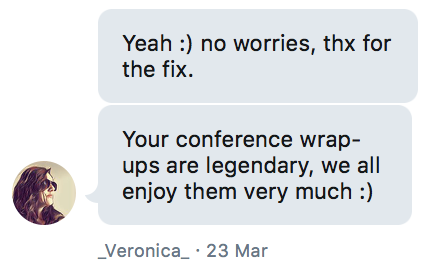
I can’t remember why I started to write conference wrap-ups but it started in 2009 when I attended my first Hack.lu! I had a quick look at my blog archives and, until today, I wrote 184 wrap-ups!  The initial idea was probably to bring some material to colleagues who did not have the chance to attend the conference in Luxembourg. Quickly I got some very positive feedbacks from my existing blog readers and it started to attract more and more people. 

Wrap-Up Feedback

Why am I still writing such kind of articles today? For multiple reasons… The first one is personal: It helps me to learn new stuff. The exercise to keep the focus on a speaker and to take notes on the fly is complex. You need to listen, understand and summarize in real time. Usually, I’m writing very synthetic notes and I force myself to beautify the text the same day (otherwise, I’m quickly losing details). Often, my wrap-ups are published during the night.

The second one is for the community… If I’ve some content, why not share it? Honestly, based on the number of infosec events I’m attending,  I consider myself as a lucky guy. With my wrap-ups, I can share a (very) small piece of information that I collected. They are published “as is” without any restriction and review (read: errors can always be present!). I know that some people reuse them even if they attended the same conference. They need to report some content internally in their organization 😉 They are free but be fair to keep a link to the original article.

It won’t change and, next week, I’ll be in Luxembourg for hack.lu. Immediately after, I’ll fly to Budapest for Hacktivity. Hack.lu is one of my preferred events not only for the quality of the schedule but also for the relaxed atmosphere. I meet some friends once a year at hack.lu! My first participation was in 2008 and this edition promises to be awesome with a bunch of interesting talks. Here is my pre-selection:

  • Randori, a low interaction honeypot with a vengeance (Bouke van Laethem)
  • Device sensors meet the web – a story of sadness and regret (Lukasz Olejnik)
  • The Bicho: An Advanced Car Backdoor Maker (Sheila Ayelen Berta, Claudio Caracciolo)
  • Keynterceptor: Press any key to continue (Niels van Dijkhuizen)
  • Sigma – Generic Signatures for Log Events (Thomas Patzke)
  • Front door Nightmares. When smart is not secure (ObiWan666)

Then, let’s go to Hacktivity. Contrariwise, it will be my first experience with this event. The conference has a very good reputation. A lot of nice topics and here is my pre-selection:

  • REST API, pentester’s perspective (Mateusz Olejarka)
  • Exploiting USB/IP in Linux (Ignat Korchagin)
  • Hacking drones and buying passwords in the Darknet (Tobias Schrödel)
  • A heaven for Hackers: Breaking Log/SIEM Products (Mehmet Ince)
  • BlueBorne Explained: Exploiting Android devices over the air (Ben Seri Gregory Vishnepolsky)

You can expect a massive amount of Tweets and daily wrap-ups during the week! Stay tuned and thanks again for reading my delusions…

[Note: You can follow the upcoming conferences that I will attend on the right side of this page in the “Upcoming Events” section]


[The post Wrap-Ups Storm Ahead! has been first published on /dev/random]


from Xavier