Saturday, May 6, 2017

[SANS ISC] The story of the CFO and CEO…

I published the following diary on isc.sans.org: “The story of the CFO and CEO…“.

I read an interesting article in a Belgian IT magazine[1]. Every year, they organise a big survey to collect feelings from people working in the IT field (not only security). It is very broad and covers their salary, work environments, expectations, etc. For infosec people, one of the key points was that people wanted to attend more trainings and conferences… [Read more]

[The post [SANS ISC] The story of the CFO and CEO… has been first published on /dev/random]


from Xavier

Friday, May 5, 2017

[SANS ISC] HTTP Headers… the Achilles’ heel of many applications

I published the following diary on isc.sans.org: “HTTP Headers… the Achilles’ heel of many applications“.

When browsing a target web application, a pentester is looking for all “entry” or “injection” points present in the pages. Everybody knows that a static website with pure HTML code is less juicy compared to a website with many forms and gadgets where visitors may interact with it. Classic vulnerabilities (XSS, SQLi) are based on the user input that is abused to send unexpected data to the server… [Read more]

[The post [SANS ISC] HTTP Headers… the Achilles’ heel of many applications has been first published on /dev/random]


from Xavier

Wednesday, May 3, 2017

Singapore: Realizing that for the future to be smart, it needs to be secure

In 2005, just over a decade ago, the majority of large internet user populations, certainly as a percentage of their total national population, were still to be found in North America and Europe. In 2025, less than a decade from now, many of the largest internet user populations will be in Asia. Asia will be a fulcrum of cyberspace and it will also be, inevitably, a fulcrum of both cybercrime and cybersecurity. As such, cybersecurity policy decisions being made today in Asia will significantly shape cyberspace in 2025 and beyond. Given the interconnected nature of cyberspace, their impact will be global.

While many analysts focus on Asia’s large political and economic players, such as Tokyo and Beijing, I will take a look at Singapore, whose smaller size has allowed it to be agile and power ahead in terms of online innovation. It is clear that the government realized that technology is central to both the country’s current economic success and its future prospects. Not only has it strived to make Singapore a hub for industries highly reliant on technology, such as financial services, it has focused its investments to ensure the country can become a true “Smart Nation”. That has meant being bold in adopting new technologies and, on occasion, facilitating experimentation, for example through the recently outlined a “big data sandbox” initiative.

Moreover, Singapore has also realized that it can only be successful in this space if it can adopt technology securely. Its approach, which is to give clear guidance to key parts of the economy and to cooperate closely with the private sector to help create, refine and enact that guidance with an eye to ensuring future innovation, is a worthwhile example for other Asian governments. Its early push in ensuring key industry sectors can move to the cloud securely through the adoption of the Multi-Tier Cloud Security standard, has been followed by complementary initiatives, such as the Cloud Implementation Guide, developed by the Association of Banks in Singapore (ABS). Central to the success of both of the documents has been a close partnership with those they intended to guide, i.e. both cloud providers and those adopting new technologies. This mirrors the positive model of public-private engagement that underpinned the successful NIST Cybersecurity Framework in the United States.

More recently, the Singaporean Cybersecurity Agency (CSA) has made cybersecurity even more of a priority for the country. The Cybersecurity Strategy, launched in October 2016, aims to build a resilient and trusted cyber environment by focusing on four pillars: i) Building a Resilient Infrastructure; ii) Creating a Safe Cyberspace; iii) Developing a Vibrant Cybersecurity Ecosystem; and iv) Strengthening International Partnerships. First outcomes can already be seen, with the revised Cybercrime Act adopted in April.

Moreover, the government has already begun consultations on its Cybersecurity Act, which we expect to be introduced by the end of the year. It will be interesting to observe whether Singapore follows models that have been put forward by the above-mentioned NIST Cybersecurity Framework, or takes an approach closer to that put forward by the European Union with the Network and Information Security Directive. On the other hand, it could put forward its own model. After all, frameworks for protecting critical infrastructure online are evolving. Countries are debating the benefits of regulatory vs. voluntary approaches, struggling to balance information sharing and incident reporting, and managing the role of regulators in an area that cuts across typical boundaries between industry sectors.

Singapore is not, however, only looking inwards. It is making an active contribution to regional cybersecurity, having launched an ASEAN Cyber Capacity Program (ACCP). As well as capacity-building activities, developing technical skills, and incident response capabilities, the ACCP will support discussion and consultancy work in areas such as the creation of national cybersecurity agencies, cybersecurity strategies, and even cybersecurity legislation. This initiative highlights an important understanding: that in an interconnected world, an individual, organisation or state is only as safe in cyberspace as its weakest link.

Although I remain concerned that Singapore’s approach to network separation could create problems for government, business and citizens, what distinguishes Singapore’s approach, overall, is its determination to tackle cybersecurity without cutting off its connections to the region and the world. Perhaps for an island nation that depends upon commerce the logic of putting up barriers is particularly inimical, but it nonetheless demonstrates that it can be done: governments can build cybersecurity without harming openness and innovation. Looking at Singapore, I would hope that other governments, not just in Asia but around the world, can see that infrastructure, businesses and citizens can all be protected without the loss of the interconnectedness and opportunities of cyberspace.


from Paul Nicholas

A DDoS tsunami is coming to cost companies in millions

DDos attacks will cause damages in millions to unprepared companies

A study was just released by cyber security firm Neustar Security that confirms the fear of many IT professionals and executives in big and small organizations alike. DDoS attacks are rapidly increasing in number and they are becoming more and more powerful.

The firm’s head of research and development fears that enough precautions have not been taken to prevent DDoS by many companies. His company is trying its best to spread awareness of the DDoS by releasing statistical data about how damaging these attacks can be. If your organization isn’t prepared, you’ll face massive losses.

Read more details 

The post A DDoS tsunami is coming to cost companies in millions appeared first on Cyber Security Portal.


from Gilbertine Onfroi

Tuesday, May 2, 2017

Who’s Visiting the Phishing Site?

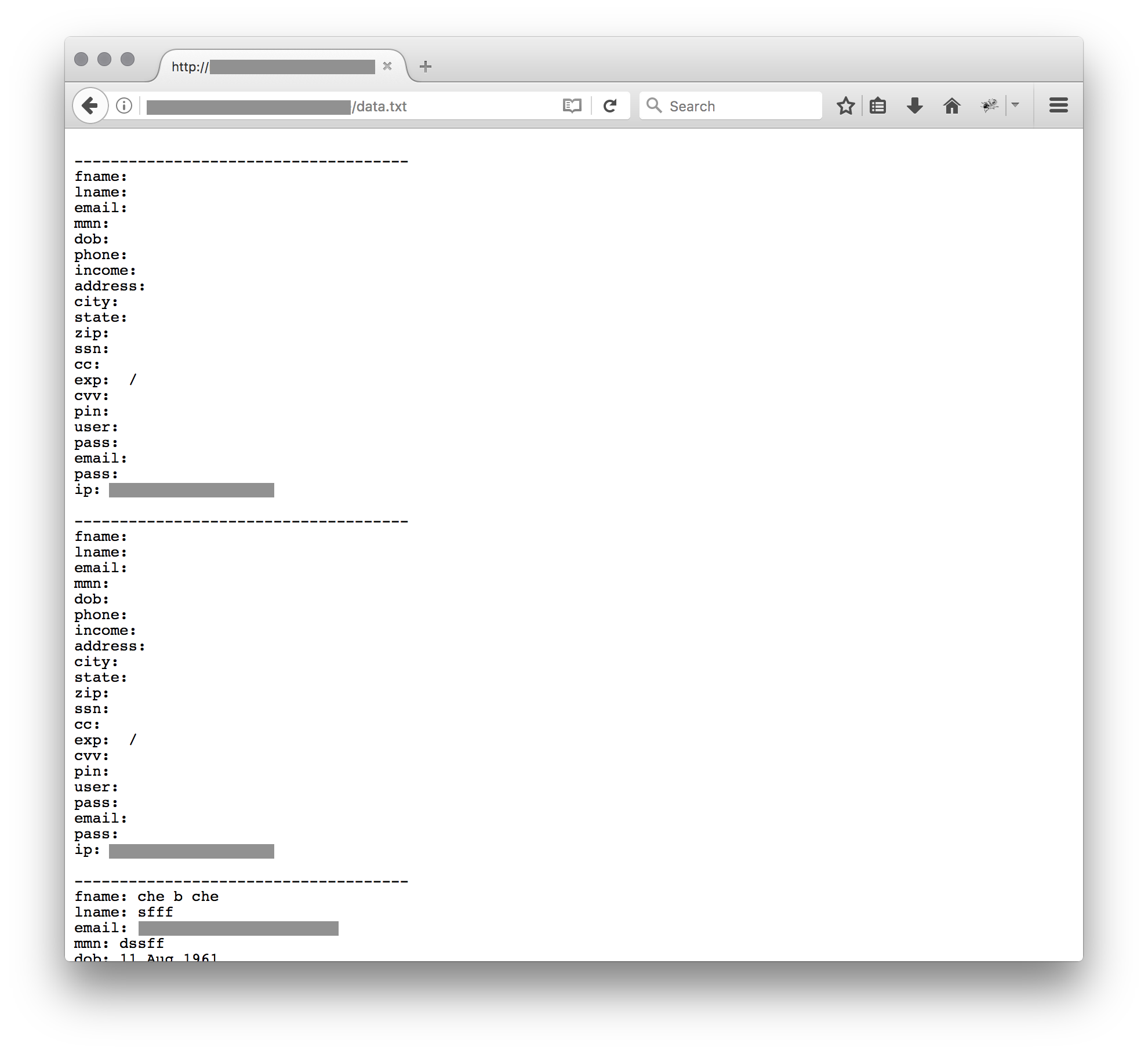
Today, while hunting, I found a malicious HTML page in my spam trap. The page was a fake JP Morgan Chase bank. Nothing fancy. When I found such material, I usually search for “POST” HTTP requests to collect URLs and visit the websites that receive the victim’s data. As usual, the website was not properly protected and all files were readable. This one looked interesting:

Data File

The first question was: are those data relevant. Probably not… Why?

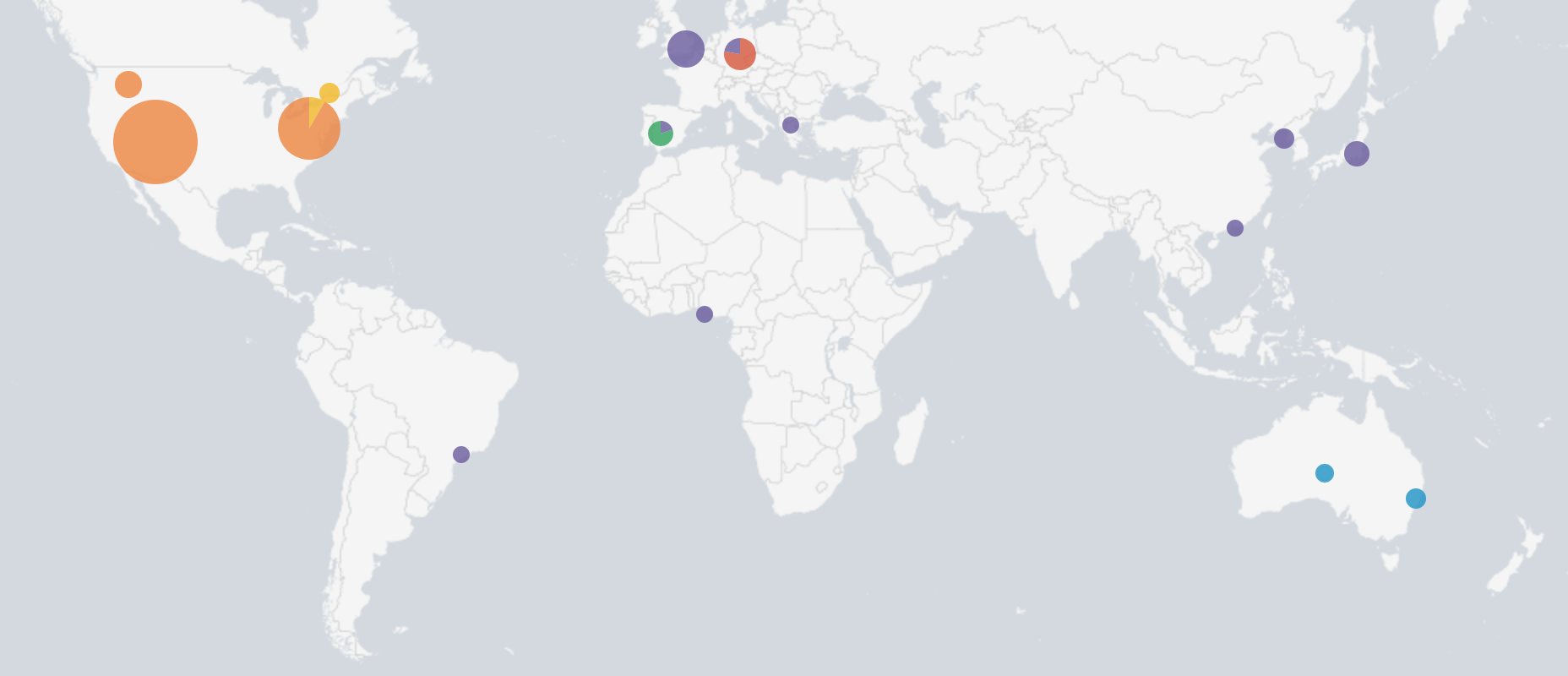
Today, many attackers protect their malicious website via an .htaccess file to restrict access to their victims only. In this case, the Chase bank being based in the US, we could expect that most of the visitors’ IP addresses to be geolocalized there but it was not the case this time. I downloaded the data file that contained 503 records. Indeed, most of them contained empty or irrelevant information. So I decided to have a look at the IP addresses. Who’s visiting the phishing site? Let’s generate some statistics!

$ grep ^ip: data.txt |cut -d ' ' -f 2 | sort -u >victims.csv
$ wc -l victims.csv
150

With Splunk, we can easily display them on a fancy map:

| inputlookup victims.csv | iplocation IP \
| inputlookup victims.csv | iplocation IP \
| stats count by IP, lat, lon, City, Country, Region

IP Map

Here is the top-5 of countries which visited the phishing page or, more precisely, which submitted a POST request:

United States 64
United Kingdom 13
France 11
Germany 7
Australia 5

Some IP addresses visited multiple times the website:

37.187.173.11 187
51.15.46.11 77
219.117.238.170 21
87.249.110.180 9
95.85.8.153 6

A reverse lookup on the IP addresses revealed some interesting information:

  • The Google App Engine was the top visitor
  • Many VPS providers visited the page, probably owned by researchers (OVH, Amazon EC2)
  • Service protecting against phishing sites visited the page (ex: phishtank.com, phishmongers.com, isitphishing.org)
  • Many Tor exit-nodes
  • Some online URL scanners (urlscan.io)
  • Some CERTS (CIRCL)

Two nice names were found:

  • Trendmicro
  • Trustwave

No real victim left his/her data on the fake website. Some records contained data but fake ones (although probably entered manually). All the traffic was generated by crawlers, bot and security tools…

[The post Who’s Visiting the Phishing Site? has been first published on /dev/random]


from Xavier

Monday, May 1, 2017

Mind the air gap: Network separation’s cost, productivity and security drawbacks

In some of my recent discussions with policy-makers, network separation, i.e. the physical isolation of sensitive networks from the Internet, has been floated as an essential cybersecurity tool. Why? It promises the holy grail of security, i.e. 100% protection, because cyberattacks can’t cross the “air gap” to reach their target.

In my experience, however, network separation has its place in the governments’ cybersecurity toolkit but it also suffers from significant drawbacks. These include: costs of implementation and maintenance; diminished productivity; and, perhaps counterintuitively, degradation in some key aspects of security. Overall, network separation is out of step with a world where systems’ interconnectivity is underpinning innovation driven by cloud computing and the Internet of Things (IoT). I’m going to use this blog to look a little more closely at these issues.

Network separation is an established and recognized security practice in critical sectors, e.g. classified military networks or nuclear power plants. The potential consequences of these systems being compromised are sufficiently bad to justify any downsides that network separation might introduce. However, as governments consider implementing network separation more broadly, that cost/benefit calculation must change.

Looking at costs alone, creating separate networks means increased expenditure of limited resources and reduced economies of scale. An “air gap” demands creating a whole new network with standalone servers, routers, switches, management tools, etc. That network needs to be built to deliver the foreseeable peak demand, which might only occur every now and then. This largely unused capacity is effectively wasted, whereas a non-separated network could simply use temporary cloud resources to “scale up” when needed. Costs increase further because software maintenance cannot be done by a remote centralized hub, whilst physical maintenance is more time consuming.

Network separation can also harm efficiency, productivity and usability. An “air gap” creates barriers to the outside world, which most government workers need to best serve their constituencies. Having to turn attention and move information between different devices, some separated and some not, would be time consuming at best and confusing at worst. And many government services and systems that are meant to interact directly with citizens are likely to be slowed and made more cumbersome by separation protocols. The benefits of smart cities and smart nations will be significantly diminished if governments forsake cloud and IoT benefits in the name of network separation.

Finally, even network separation’s security benefits are not foolproof. For one thing, being disconnected from threats frequently means being disconnected from cybersecurity innovation, let alone mundane security tools such as patches. Moreover, the assumption of being safe on the other side of an “air gap” can mean staff and management take essential security basics for granted. Indeed, a poor cybersecurity culture within any organization means social engineering or human error can give malicious actors a way into a system, e.g. as employees circumvent cumbersome requirements by relying on their private (and often insecure) email.

Furthermore, the “air gap” itself can be circumvented. Just one connection with the outside world creates a single point of failure for malicious actors to exploit and even with no direct connection there are ways “in”. As Stuxnet showed, removable media such as USB drives can insert malware into physically separated hardware, whilst some forms of hacking are able to “jump” the “air-gap”, e.g. USBee (a “software-only method for short-range data exfiltration using electromagnetic emissions from a USB dongle”) and AirHopper (turns a computer’s video card into an FM transmitter to collect data from “air-gapped” devices).

For governments concerned about the growing scale, frequency, sophistication and impact of cyberattacks there can be legitimate reasons for adopting network separation. In limited sets of circumstances, e.g. protecting classified networks, it can be part of an appropriate, risk-management based cybersecurity response. That being said, it is essential for governments to understand the tradeoffs in cost, usability, and effectiveness that the approach introduces. Network separation is not and cannot be the right or the only answer to all of their cybersecurity concerns.


from Paul Nicholas

"Phishing Lightening Talk - At the #SecAwareSummit"

Editor's Note: Tonia Dudley is the Director of Security Awareness in the Financial Services industry. She is one of the speakers for the upcoming Security Awareness Summit 2/3 Aug in Nashville, TN. Below she discusses her upcoming talk on fine tuning your phishing program as part of the hour of Phishing Lightning talks. Many organizations … Continue reading Phishing Lightening Talk - At the #SecAwareSummit

from lspitzner